

Novelty Structures offers Contract Manufacturing and Fabrication Services through our facilities in Turkey.
Contract Fabrication Services
We provide contract metal fabrication and CNC machining services for industrial clients requiring precision, reliable and scalable manufacturing solutions.
Our expertise combines advanced fabrication processes with high-accuracy machining to deliver engineered metal components and assemblies for a wide range of industries and international markets.

Contract Metal Fabrication Capabilities
Our metal fabrication services include CNC laser cutting, profile cutting, press brake forming, section rolling, coded welding (MIG, TIG, MMA), and full mechanical assembly. We work with carbon steel, stainless steel, and aluminium, producing components that meet strict dimensional tolerances and structural requirements.
All fabrication is carried out in accordance with qualified procedures (WPS/PQR), ensuring repeatability, weld integrity, and compliance with project specifications. We support both custom metal fabrication and high-volume production runs, depending on client requirements.
Contract CNC Machining Services
Our Contract CNC machining services utilise multi-axis machining centres to manufacture complex geometries with tight tolerances. We produce both standalone machined parts and carry out secondary machining on fabricated components, ensuring full dimensional accuracy across assemblies.
We work from 2D engineering drawings and 3D CAD models, applying GD&T principles to meet critical tolerances and functional requirements. Our machining capabilities support industries requiring precision engineering and repeatable production quality.
Our capabilities include:
Contract Manufacturing of Pressure Equipment
Pressure equipment fabrication involves the design, manufacturing, and assembly of components that withstand high-pressure conditions in industrial applications.
At Novelty Structures, our expertise ensures precision, durability, and compliance with industry standards.
International Manufacturing Experience
We have extensive experience delivering projects across Europe and North America markets, working with a wide range of technical standards and regulatory environments. Our team is experienced in adapting to EN, ISO, and project-specific requirements, ensuring full compliance and documentation for international clients.
Our cross-market experience allows us to support industries such as:
- Machinery & Construction
- Mechanical and plant engineering
- Energy and infrastructure
- Industrial pipework and process systems
Quality Assurance & Engineering Support
We operate a fully integrated manufacturing process, including design for manufacture (DfM), certified material procurement, in-process inspection, and final quality control. Our systems ensure traceability, dimensional verification, and weld inspection, meeting the expectations of technically demanding projects.
As a trusted contract manufacturing partner, we focus on process control, lead time optimisation, and cost efficiency.
Whether delivering prototype components, bespoke fabrications, or large-scale production, we provide consistent quality and dependable delivery.
Challenges in Contract Metal Fabrication Projects
Outsourcing metal fabrication and contract manufacturing can unlock substantial production capacity and cost savings, but managing projects across borders brings its own set of practical challenges. Even when suppliers are in neighbouring countries or elsewhere within the same continent, differences in language, working practices and transport arrangements can turn small oversights into expensive surprises.
Understanding where things typically go off track—and adopting practical, people-centred habits to prevent them—can make the difference between a smooth delivery and a logistics nightmare. Here is a look at seven common challenges in contract manufacturing between neighbouring countries or countries within the same continent, along with practical ways to keep your projects running smoothly.
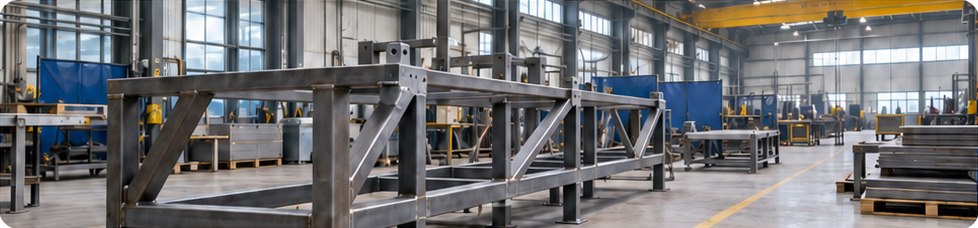
Steel frame fabrication
1. Misunderstood Technical Requirements
The Issue
Engineering drawings don’t always translate cleanly from one country to another. Simple things like how surface finishes are specified, differences in drawing conventions, or implicit assumptions about hole tolerances can lead to parts that look fine on paper to the factory, but don’t fit together on your assembly floor.
A Typical Scenario
Imagine ordering a batch of custom steel frames for an automated conveyor system. The drawing has an unannotated mounting pattern that your local team assumes is standard precision, but the supplier in another country interprets it as an open, loose tolerance. When the first delivery arrives, the mounting holes are off by just 2 mm—making the entire load of frames impossible to assemble without extensive rework.
Practical Ways to Fix It
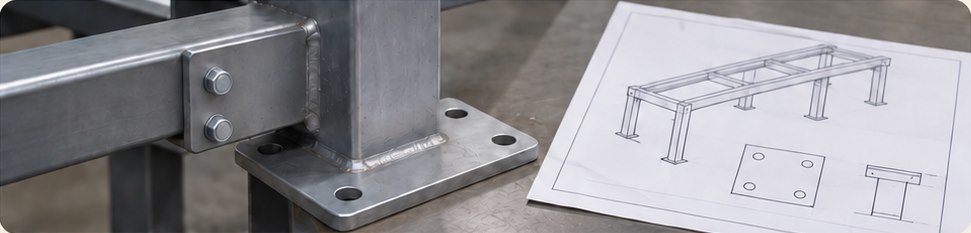
Steel frame mounting detail
2. Drawing Changes and Obsolete Parts
The Issue
Fast-moving projects mean design updates happen often. When an engineering change order (ECO) is issued mid-production, cross-border delays can mean the shop floor keeps making the old version while your team thinks they’ve already switched to the new one.
A Typical Scenario
Picture a scenario where your engineering team moves a mounting bracket over by 25 mm to accommodate a new motor. The updated drawing is emailed over, but the factory floor has already stamped out 1,000 panels of the old version. Both the old and new parts end up packed into the same crate, leaving your receiving team to manually sort through boxes to figure out which ones actually work.
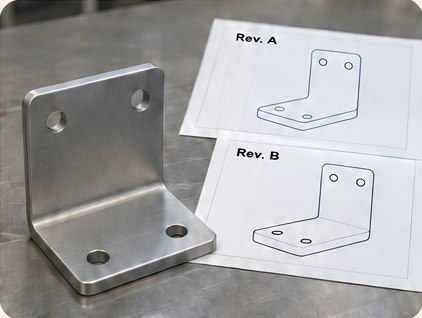
Bracket revision control
Practical Ways to Fix It
3. Material Substitutions or Incomplete Traceability
The Issue
Global raw material supplies can fluctuate unpredictably. If a specific steel grade is out of stock, a supplier might swap in a local equivalent to keep production moving, assuming it’s “close enough”—even if it lacks the strength or corrosion resistance your product actually needs.
A Typical Scenario
Consider a batch of structural outdoor enclosure specified for 316 stainless steel to handle harsh weather. To meet a tight deadline, the supplier swaps in 304 stainless without mentioning it, thinking the difference is minor. A few months after installation, surface rust starts blooming across the hardware, leading to unhappy customers and unexpected replacement costs.
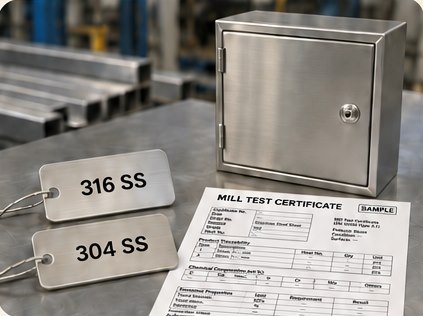
Material traceability
Practical Ways to Fix It
4. Inconsistent Quality Between Batches
The Issue
The initial prototype sent for approval often receives special care from the supplier’s top technicians. Once full production begins, changes in machine setups, worn cutting tools, or new workers on the line can cause quality to slip over time.
A Typical Scenario
A first batch of precision sheet metal enclosures arrives looking flawless. But by the third order, edges feel sharp and burred, the powder coating is uneven, and the cabinet doors stick when opened. The factory simply rotated new operators onto the line and hadn’t checked their tool wear.
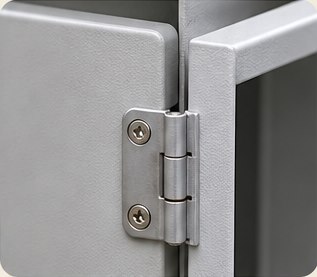
Enclosure finish inspection
Practical Ways to Fix It
5. Late Deliveries and Limited Progress Visibility
The Issue
Distance makes it hard to know what’s really happening on the shop floor. Getting a polite “everything is on track” email every week doesn’t help if a bottleneck is quietly brewing behind the scenes.
A Typical Scenario
Suppose you’re promised a six-week lead time for a delivery of heavy fabrications. Every weekly status update confirms production is on schedule. But in week six, when the parts are supposed to be loaded onto a lorry, you find out the raw steel plate was delayed at the mill and cutting hasn’t even started yet, pushing your project back by a month.
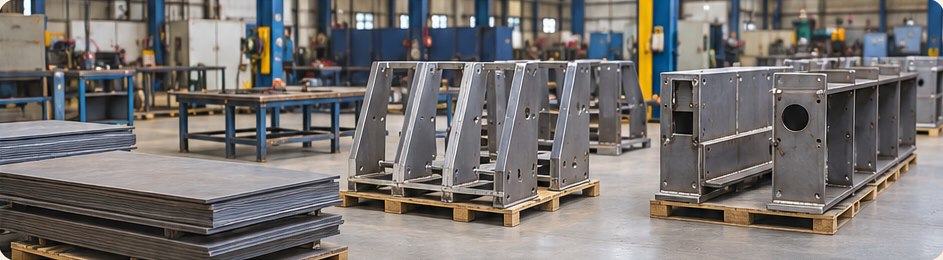
Fabrication progress review
Practical Ways to Fix It
6. Communication Gaps Across Languages and Working Hours
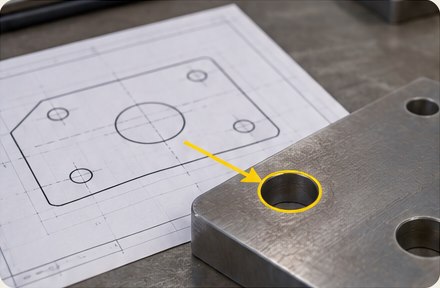
Drawing review
The Issue
Even neighbouring countries can have different working hours, public holidays or time zones, so a simple question may not receive an immediate answer. Add in language differences, and subtle technical questions can easily be misunderstood.
A Typical Scenario
An engineer emails a factory asking: “Can we hold a tighter 0.05 mm tolerance on this hole, or should we leave it at 0.1 mm?” The contact representative replies with a brief “Yes,” leaving your team guessing which option was actually agreed upon.
Practical Ways to Fix It
7. Quality Problems Are Difficult to Resolve After Delivery
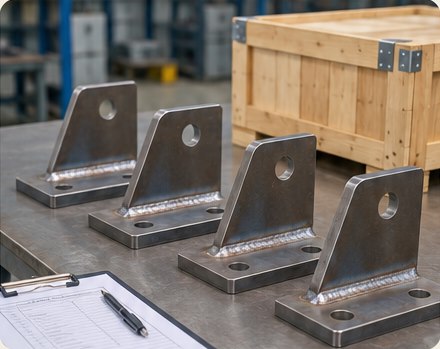
Bracket inspection before despatch
The Issue
Discovering defective parts after they’ve arrived at your premises can disrupt the entire project. Returning heavy metal fabrications to a supplier in another country for rework can add transport costs and delay production, even when the supplier is relatively close.
A Typical Scenario
A delivery of 500 welded brackets arrives at your facility, but your team discovers the mounting flanges were welded at the wrong angle. The factory offers to replace them on the next production run in two months, but your production line is stopped now. You’re forced to hire local welders to cut and re-weld every piece at three times the original cost.
Practical Ways to Fix It
Managing cross-border contract fabrication means setting up practical processes that prevent minor misunderstandings from growing into costly mistakes. By staying connected, keeping communication clear, and inspecting work at key milestones, you can benefit from manufacturing partnerships in neighbouring countries or elsewhere within the same continent while keeping your delivery schedules intact.
How can we help you ?
Novelty Structures’ manufacturing capabilities joined with our excellent supplier/subcontractor network makes us a comprehensive partner in contract manufacturing.
Whether your project involves small-scale prototyping or large-scale production, Novelty Structures’ capabilities are designed to meet a broad scope of industry demands efficiently.
