

Novelty Structures is an expert manufacturer of Large Part Machining and Fabrication services for various industries.
- Horizontal Boring Mills
- Large Part Machining Operations
- Industries Served by Large Part Machining
- Tolerances Achieved in Large Part Machining
- Quality Control
- Visual Inspection
- Dimensional Inspection
- First Article Inspection
- Surface Finish Inspection
- Large Machining Cost Calculation
- Case Study 1: Identifying Critical Dimensions to Reduce Machining Costs
- Case Study 2: Maintaining Alignment on a Dual-Bearing Housing
- Case Study 3: Resolving Deep-Hole Tolerances on a Three-Metre Shaft
- FAQ
- What is contract CNC machining?
- What types of CNC machines do you use?
- What is your typical lead time for projects?
- Can you provide finishing services?
- Can you handle large parts or assemblies?
- Can you machine custom threads or specialized features?
- What are your shipping options?
- Can you integrate CNC machining with other manufacturing processes?
- Do you machine small or intricate parts?
- Are there specific design guidelines I should follow for CNC machining?
- What is your process for handling defective parts?
- Do you offer post-production assembly?
- Why Large Part Machining Matters
- Knowledge Hub
Manufacturing large components with precision and efficiency requires specialised equipment and expertise.
Novelty Structures provides large component machining services tailored to industries where size and accuracy are critical.
Using advanced machining equipment, skilled technicians, and rigorous quality control processes, Novelty Structures ensures that oversized parts meet exact specifications.
The following sections outline Novelty Structures’ large part machining capabilities, including machining operations, equipment, tolerances, and industries served.


Large Part Machining Operations


Quality Control
Large Machining Cost Calculation
Case Study 1: Identifying Critical Dimensions to Reduce Machining Costs
When reviewing the initial drawing for a large component project, Novelty Structures noticed that tight tolerances were specified across both functional interfaces and secondary surfaces. Machining every surface to uniform precision would have added substantial machine time without providing any functional benefit to the client.
Our team met with the client’s engineers to review how the component fit into the larger assembly. Together, we identified the key dimensions governing fit and alignment. We maintained tight tolerances on those critical locating features while opening up tolerances on areas where precision was less important.
This revision gave us greater flexibility when planning machining operations and eliminated unnecessary finishing passes. As a result, the client achieved clear savings in machining time and production costs, while all functional requirements were fully preserved.
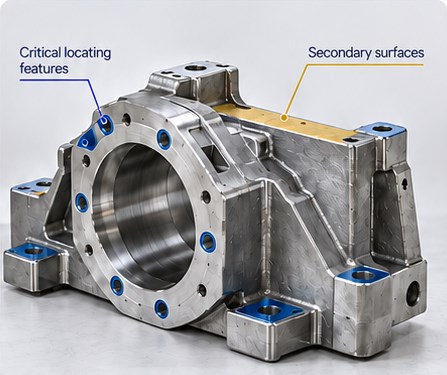
Machined locating features
Case Study 2: Maintaining Alignment on a Dual-Bearing Housing
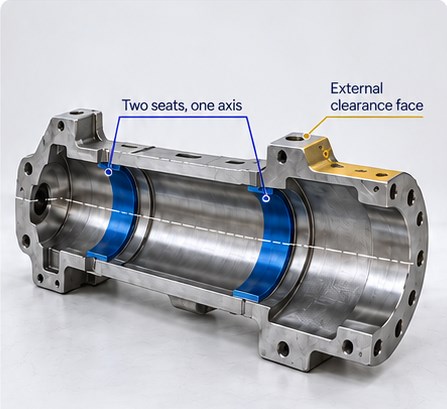
Dual-bearing housing
On a project involving a large bearing housing designed to support a single shaft across two internal seats, the drawing specified tight tolerances across the entire exterior of the housing block.
During our technical review, Novelty Structures pointed out that tight control over external clearance faces did not affect shaft alignment or bearing performance. The essential requirement was the relationship between the two internal bearing seats: their diameters needed to provide the exact fit, and their axes needed to align accurately to prevent binding.
We worked with the client’s engineering team to classify the bearing seats and their reference datums as the sole critical features. The updated drawing retained strict fit and alignment requirements for the seats while relaxing tolerances on external surfaces. This allowed our shop floor to sequence operations around the functional interfaces and focus inspection on seat alignment and bore dimensions.
Case Study 3: Resolving Deep-Hole Tolerances on a Three-Metre Shaft
During a project involving a three-metre-long shaft, Novelty Structures identified a manufacturing issue with a tight tolerance specified along the full depth of a deep internal bore. Holding that degree of precision continuously over a three-metre length was unfeasible with standard deep-hole tooling.
We reviewed the application with the client’s engineers to clarify where the precision was functionally necessary. The review revealed that the mating shaft component only engaged tightly near the opening of the hole.
Both teams agreed to revise the drawing, applying the tight tolerance strictly to the final 100 mm at the edge of the hole while allowing wider tolerances along the remaining depth of the shaft. This change preserved the precision required for fit and assembly while establishing a reliable, straightforward machining process for the rest of the feature.
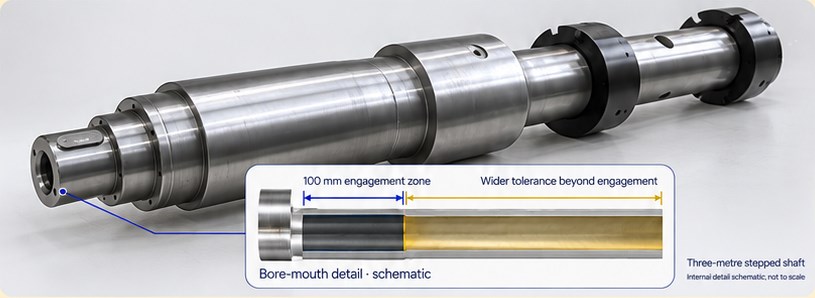
Three-metre stepped shaft. Bore-mouth detail is schematic and not to scale; the 100 mm engagement zone is followed by a bore with wider tolerance.
FAQ
Contract CNC machining refers to outsourcing precision manufacturing tasks to a specialized provider. These services involve computer-controlled machining processes to produce high-quality parts or components from various materials, including metals, plastics, and composites.
Our facility utilizes a wide range of CNC machines, including:
- CNC mills
- CNC lathes
- 5-axis machining centers
- Swiss-style lathes
- CNC routers
Lead times depend on project complexity, material availability, and order volume. Prototyping projects often take 1-3 weeks, while production runs may take 4-8 weeks. Expedited services are available for urgent needs.
Yes, we offer a variety of finishing services, including:
- Anodizing
- Powder coating
- Polishing
- Sandblasting
- Heat treatments
- Plating (e.g., chrome, nickel)
Yes, we have CNC machines capable of handling large parts and assemblies. Our facilities include machines with extended work envelopes and multi-axis capabilities to accommodate oversized or complex components.
Yes. We can machine custom threads (both internal and external) and create specialized features such as undercuts, thin walls, deep pockets, and complex contours based on your specifications.
We ship globally using a variety of carriers. Depending on your location and urgency, we can provide standard shipping, expedited shipping, or freight options for large orders.
Yes, we can combine CNC machining with other processes such as injection molding, die casting, 3D printing, and metal stamping for a complete manufacturing solution.
Yes, our precision CNC machines are equipped to produce small, intricate components with features like micro-holes, fine threads, and detailed engravings.
Yes, to ensure manufacturability, consider the following:
- Avoid overly thin walls or deep pockets.
- Specify radii for inside corners.
- Use standard hole sizes where possible.
- Minimize excessive tolerances unless necessary.
If defective parts are identified, we will replace them free of charge. We work closely with our clients to address any issues promptly and improve future production runs.
Yes, we provide post-production assembly services, including mechanical assembly, fastening, and packaging, depending on your project’s needs.

How can we help you ?
Novelty Structures stands out as a reliable partner in providing high-quality Large Part Machining services tailored to demanding industrial needs.

