

Novelty Structures provides contract fabrication of Stainless Steel Tanks for Various Industries
Stainless Steel Tank Fabrication Service
Novelty Structures manufactures stainless steel tanks for various industries from food storage to chemical mixing tanks. They come in various types, including storage, mixing and pressure with components like tank bodies, nozzles, and safety features tailored to specific applications.
Besides aluminium and carbon steel tanks, our expertise in stainless steel fabrication is a testament to our quality.

Applications using Stainless Tanks
Types of Stainless Tanks

Case Study 1: Keeping a Storage Tank Aligned During Fabrication
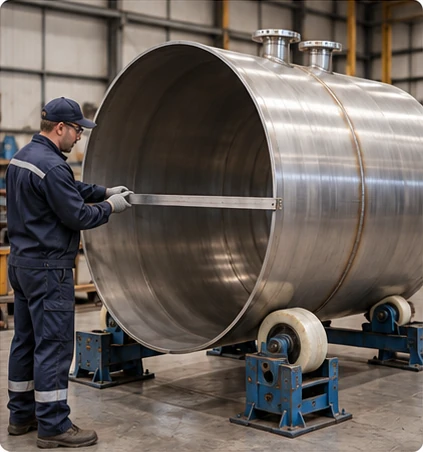
Tank shell alignment
A client required a stainless steel storage tank that would connect to existing pipework. The connection positions were fixed, so maintaining the tank’s shape during fabrication was important to the installation.
During assembly, our dimensional checks identified that the shell had started to move out of alignment as welding progressed. Continuing at that stage could have made it more difficult to fit the remaining sections and position the connections accurately.
We addressed the issue through the following steps:
The issue reinforced the importance of checking geometry throughout fabrication. For tanks connecting to an existing installation, we identify the critical dimensions at the outset and use them as reference points during assembly and final inspection.
Case Study 2 : Resolving Internal Weld Discolouration Before Closing a Mixing Tank
A client’s stainless steel mixing tank included internal fittings that would become difficult to access once the top section was installed. We planned an inspection before closing the tank so the internal welds could be checked while they were still accessible.
That inspection identified heat discolouration around part of an internal weld. The area needed attention because welding-related oxidation can reduce the corrosion resistance of the affected surface.
We addressed the finding before proceeding:
Only after that check did the assembly continue.
The important decision was to inspect before access became restricted. On tanks with enclosed sections or internal equipment, we plan the sequence around welding, inspection and finishing access together, so an issue can be addressed before another component covers it.
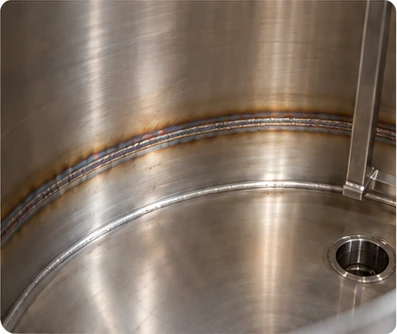
Internal weld inspection
Case Study 3 : Investigating Rust Staining on a Stainless Steel Tank
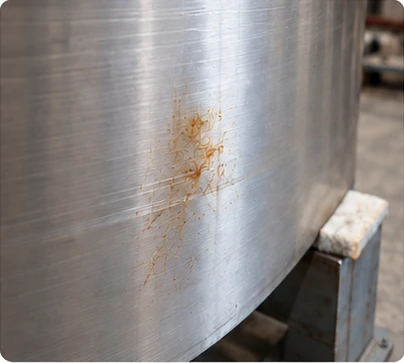
Tank surface inspection
During a pre-dispatch inspection of a client’s stainless steel tank, we noticed localised rust staining on an external surface. We held the tank for investigation before carrying out further finishing.
The review traced the staining to iron contamination introduced through contact with workshop handling equipment. The problem was on the surface: stainless steel can develop rust stains when particles from carbon steel are transferred onto it.
Our response covered both the tank and the source of contamination:
The incident showed why final cleaning alone is insufficient. Preventing a recurrence required attention to how the tank was supported and moved between fabrication stages, as well as how its finished surface was protected before dispatch.
Fabrication Steps of Stainless Steel Tanks


FAQ
We fabricate a variety of steel tanks, including:
- Vertical and horizontal storage tanks
- Pressure vessels
- Double-walled tanks
- Custom-designed tanks
- Stainless steel and carbon steel tanks
Yes, our fabrication services are fully customizable. We can design tanks to meet your specific size, capacity, material, and industry standards. Our team works closely with clients to ensure all requirements are met, including compliance with regulatory codes.
We primarily use stainless steel and carbon steel, depending on the application and environmental conditions. Stainless steel is ideal for applications requiring corrosion resistance, while carbon steel is often used for its strength and cost-effectiveness.
Lead times vary depending on the complexity and size of the project. Generally, smaller tanks may take a few weeks, while larger or more complex tanks may require several months. We provide detailed timelines during the project planning phase.
We maintain strict quality control processes throughout fabrication, including:
- Material testing and verification
- Welding inspections
- Hydrostatic and pressure testing
- Non-destructive testing (NDT)
- Final inspection and certification
Yes, we serve clients worldwide and coordinate international shipping for all tanks. Our logistics team ensures compliance with import/export regulations and proper handling during transit.
Pricing varies depending on factors such as:
- Size and capacity
- Material selection (e.g., stainless steel vs. carbon steel)
- Custom features and complexity
- Required certifications and testing
We provide transparent quotes and work with clients to meet their budget.
Maintenance depends on the tank’s application and environment. Regular services include:
- Visual inspections for wear, corrosion, or damage
- Cleaning and sterilization (for food-grade or potable water tanks)
- Coating reapplication
- Leak detection and repair
Yes, we can fabricate modular tanks that can be transported in sections and assembled on-site, ideal for large or remote projects.

How can we help you ?
Stainless Steel Tank Manufacturing Services are indispensable to various industries and their success depends on the careful selection of contractors.
Novelty Structures stands out as a reliable partner in providing high-quality steel tank fabrication tailored to demanding industrial needs.

