

Novelty Structures supplies contract CNC machining services for mild steel, stainless steel and aluminium
- Contract Machining in Turkey
- Contract Machining Operations
- Quality Control
- Pricing Contract Machining Works
- How can we help you ?
- Knowledge Hub
- Engineering Case Studies: Precision CNC Machining, In-Process Quality Control & Material Optimization
- Case Study 1: Contract Machining Economics & Strategic Capacity Allocation
- Case Study 2: Keeping CNC Machining Under Control Throughout Production
- Case Study 3: Material Selection — Balancing Service Performance with Machining Cost
Contract Machining in Turkey
Novelty Structures serves businesses around the world with contract machining services in Turkey to meet their production needs. These services provide a cost-effective and efficient way to outsource machining tasks such as CNC machining, turning, milling, and grinding, allowing companies to focus on their core operations while leaving the complex production processes to experts.
Contract machining, also known as subcontract machining, involves outsourcing the manufacturing of parts and components to specialised machining providers.. This includes precision processes like CNC machining, turning, milling, and surface finishing, which are essential for creating high-quality parts that meet strict industry standards. Contract machining companies typically offer both small and large-scale production runs, ensuring flexibility and scalability for businesses of all sizes.

Contract Machining Operations


Pricing Contract Machining Works
Contract Machining Economics
A CNC machine only earns a return on investment through continuous, productive operation. However, when product demand fluctuates, component geometries evolve, or specialised multi-axis operations are required only periodically, maintaining in-house machinery burdens manufacturers with fixed overhead costs that production cannot consistently recover.
A prominent industrial machinery OEM (a Novelty Structures client) was facing a critical capacity bottleneck. They were manufacturing a precision component requiring a long machining cycle time on their internal equipment. Because of the component’s lengthy cycle, it yielded a low margin on their own machines while simultaneously blocking capacity needed for higher-margin strategic orders. The client faced a costly dilemma: either commit substantial capital to purchase additional CNC machinery for a temporary surge, or sacrifice business growth.
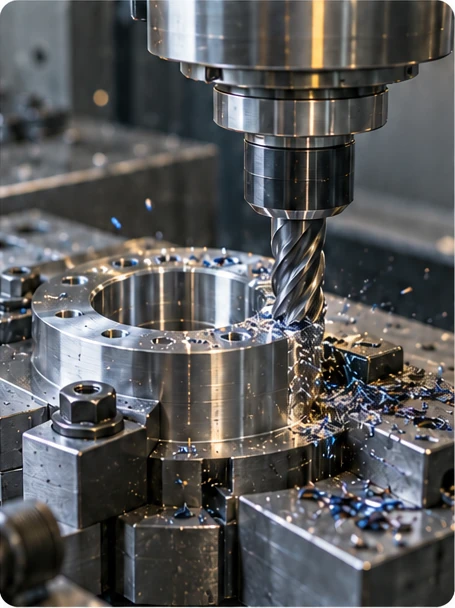
Precision component machining
Novelty Structures’ Strategic Intervention
Novelty Structures partnered with the client to transition the long-cycle part into a fully managed contract machining workflow. Novelty Structures took over full manufacturing responsibility for the component within the client’s strict target budget, establishing scheduled monthly releases.
By outsourcing this component to Novelty Structures, the client successfully released internal machine capacity to focus on urgent, higher-margin strategic orders, retaining their customer base while significantly improving overall plant profitability.
Economic Advantages of Contract Machining
The economic benefits extended far beyond the unit purchase price. To demonstrate the complete value model, the table below illustrates how our contract machining capacity addressed the client’s operational challenges:
| Economic & Operational Consideration | Novelty Structures Contract Machining Advantage |
|---|---|
| Investment in Additional Capacity | Avoids purchasing expensive machinery solely for a new component or temporary increase in market demand. |
| Uneven Machine Utilization | Allows purchasing volumes to strictly follow fluctuating operational requirements, subject to agreed batch sizes and commitments. |
| Specialist Equipment & Skills | Provides immediate access to Novelty Structures’ advanced capabilities and specialized skills without establishing each process internally. |
| Pressure on Existing Machinery | Releases internal machine capacity for urgent, strategically important, or higher-margin projects. |
| Production & Overhead Support | Reduces internal administrative and floor burdens for programming, tooling, routine maintenance, and quality inspection. |
Total Cost of Acquisition (TCO) Framework
A comprehensive comparison evaluates the total cost of acquiring acceptable finished parts rather than focusing solely on the raw purchase price. Novelty Structures works with client purchasing teams to factor in all total acquisition variables:
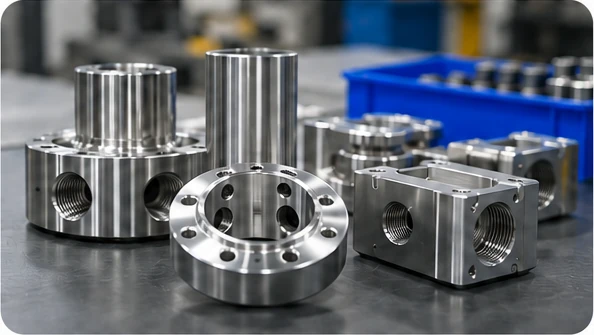
Machined components ready for release
When evaluating existing internal machinery, Novelty Structures helps clients distinguish between true cost savings that outsourcing removes (e.g., direct tooling, power, consumables, machine wear) and fixed overheads that remain, ensuring clear financial decision-making.
Case Study 1 : Continuous Quality Control
A high-precision engineering client partnered with Novelty Structures for a production run of tight-tolerance critical components. In high-precision manufacturing, a conforming first component (first-article inspection) does not guarantee that the remaining batch will stay within engineering specification.
During continuous production runs, cutting tools naturally wear, shop temperatures fluctuate, and components experience residual stress relief distortion during heavy material removal. These progressive physical variations can gradually drift a critical feature toward its tolerance limit, even when the underlying CNC G-code program remains completely unchanged.
Relying exclusively on final inspection only identifies defects after significant machining hours and high-value materials have already been consumed. The client required a proactive control framework to detect and correct variations in real time while production was ongoing.
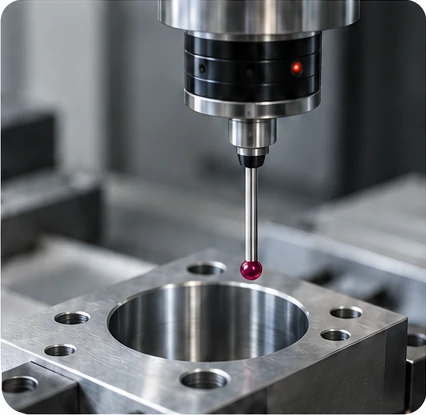
On-machine probing
Novelty Structures’ In-Process Process Control Strategy
To ensure total batch conformity, we have implemented an integrated, in-process control system based on closed-loop feedback. Novelty Structures manages tool wear, thermal effects, tool deflection, and component distortion using automated on-machine probing and tool-measurement systems.
An effective control plan connects every single measurement check directly to a clear operational decision. Novelty Structures established the following control framework across the client’s production run:
| Production Challenge | Novelty Structures In-Process Control Protocol |
|---|---|
| Incorrect Initial Setup | Verify locating references, fixture datum offsets, tool setting lengths, and critical initial features before releasing the full batch. |
| Progressive Dimensional Drift | Record measurements at scheduled intervals and review statistical trends (SPC) rather than recording simple pass/fail results. |
| Tool Wear or Breakage | Define explicit tool life criteria, automated breakage detection, and mandatory feature verification after tool changes. |
| Significant Process Interruption | Specify compulsory check routines before restarting production following pauses, shifts, or routine maintenance. |
| Abnormal Measurement Result | Enforce clear containment procedures: stop production immediately, investigate root cause, and isolate all potentially affected parts. |
On-Machine Probing & Closed-Loop Quality Assurance
Where suitable, we integrate automated on-machine probing and tool-measurement sensors into the machining centre. These devices dynamically measure critical part features mid-cycle and automatically feed parameter offsets back into the CNC controller to correct for tool wear or thermal growth before non-conformances occur.
Continuous quality control means maintaining explicit control throughout the production run; it does not require measuring every feature on every single component. Inspection frequency is tailored based on:
Case Study 2 : Material Selection — Balancing Performance with Cost
Selecting the lowest-priced raw material stock does not always yield the lowest-cost finished part. A minor upfront saving on bar stock or plate can be completely wiped out by longer cutting cycle times, accelerated tool wear, frequent cutter replacement, or mandatory secondary finishing processes.
One of our client in the process machinery sector required components machined from standard 316L stainless steel bar stock to withstand harsh corrosion and high mechanical loading. While standard 316L met all service requirements, its inherent work-hardening characteristics made it notoriously difficult to machine. The client faced high part costs driven by slow feed rates, short tool life, and frequent chip-breaking issues.
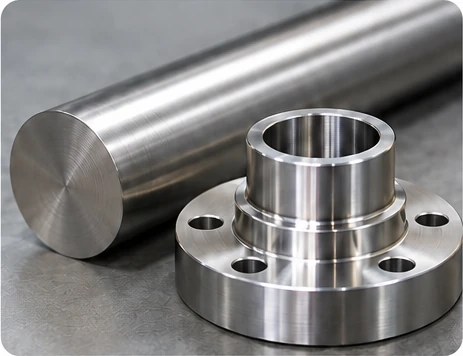
Stainless steel bar and machined part
Material-to-Process Engineering Audit
We performed a thorough evaluation starting with the part’s essential service performance requirements: mechanical loading, wear resistance, corrosion exposure, operating temperature, and post-machining joining requirements. Once performance bounds were defined, we studied d candidate alloys for manufacturing implications.
Material Selection Decision Matrix
| Material Selection Question | Engineering & Manufacturing Impact |
|---|---|
| What properties are essential in service? | Establishes non-negotiable material bounds (corrosion, strength) before cost optimization begins. |
| What grade and supply condition are required? | Provides a defined basis for assessing machinability, heat treatment, and surface treatment response. |
| How much material must be removed? | Makes material machinability index particularly vital for parts requiring heavy stock removal. |
| Which features are difficult to produce? | Deep holes, fine threads, and intricate radii make tool life and chip control major cost drivers. |
| What happens after machining? | Ensures heat treatment, welding, and surface finishing remain fully compatible with the chosen material grade. |
Optimised Material Substitution & 54% Machining Time Reduction
Material families present drastically different machining responses. Stainless steels generally exhibit greater machining challenges than standard carbon steels, and machinability varies significantly even among stainless steel grades. Tooling geometry and cutting parameters must be precisely matched to the alloy.
We identified a major optimisation opportunity within the client’s material specification. By transitioning from standard 316L stainless steel bar to a specialised, machinability-enhanced 316L variant (such as Prodec-grade 316L equivalent), Novelty Structures achieved a 54% reduction in total component machining time.
This material substitution maintained 100% compliance with standard 316L engineering specifications, retaining all required corrosion resistance, mechanical strength, and formal documentation approvals, while drastically reducing cycle time, tooling consumption, and per-part manufacturing costs.

Machined component portfolio
FAQ
Contract CNC machining refers to outsourcing precision manufacturing tasks to a specialized provider. These services involve computer-controlled machining processes to produce high-quality parts or components from various materials, including metals, plastics, and composites.
Our facility utilizes a wide range of CNC machines, including:
- CNC mills
- CNC lathes
- 5-axis machining centers
- Swiss-style lathes
- CNC routers
Lead times depend on project complexity, material availability, and order volume. Prototyping projects often take 1-3 weeks, while production runs may take 4-8 weeks. Expedited services are available for urgent needs.
Yes, we offer a variety of finishing services, including:
- Anodizing
- Powder coating
- Polishing
- Sandblasting
- Heat treatments
- Plating (e.g., chrome, nickel)
Yes, we have CNC machines capable of handling large parts and assemblies. Our facilities include machines with extended work envelopes and multi-axis capabilities to accommodate oversized or complex components.
Yes. We can machine custom threads (both internal and external) and create specialized features such as undercuts, thin walls, deep pockets, and complex contours based on your specifications.
We ship globally using a variety of carriers. Depending on your location and urgency, we can provide standard shipping, expedited shipping, or freight options for large orders.
Yes, we can combine CNC machining with other processes such as injection molding, die casting, 3D printing, and metal stamping for a complete manufacturing solution.
Yes, our precision CNC machines are equipped to produce small, intricate components with features like micro-holes, fine threads, and detailed engravings.
Yes, to ensure manufacturability, consider the following:
- Avoid overly thin walls or deep pockets.
- Specify radii for inside corners.
- Use standard hole sizes where possible.
- Minimize excessive tolerances unless necessary.
If defective parts are identified, we will replace them free of charge. We work closely with our clients to address any issues promptly and improve future production runs.
Yes, we provide post-production assembly services, including mechanical assembly, fastening, and packaging, depending on your project’s needs.

How can we help you ?
Novelty Structures provides reliable, cost-effective and high-quality machined parts and components through its workshops in Turkey. By partnering with us, companies can reduce overhead costs, improve production efficiency, and focus on other areas of their business.

