
Hardox Steel

Hardox 500 plate

Novelty Structures Delivers High-Quality Hardox Steel Fabrications for  Wear-Resistant Applications

What is Hardox Steel?

Hardox Steel is a leading brand of wear-resistant steel, produced by the Swedish company SSAB. Thanks to its exceptional quality and market dominance, Hardox has become a generic term for wear-resistant plates worldwide.

Hardox steel offers high performance in aggressive applications and wear environments meaning that it is ideal for a variety of uses that other grades of steel simply cannot perform. This is due to Hardox’s ultra-hard surface, and high level of toughness of the material composition.

Construction and Earthmoving
- Bucket liners and blades for excavators and loaders
- Dump truck beds
- Crusher parts like jaws and hammers
Mining and Quarrying
- Chutes and hoppers for material handling
- Screens and feeders
- Drill rig components
Agriculture
- Plowshares and harrows
- Trailers for abrasive loads
- Cutter blades for harvesting
Recycling
- Shredder blades and hammers
- Recycling containers
- Conveyor liners
Transportation
- Dump trailers for higher payloads
- Abrasion-resistant shipping containers
- Rail car liners
Manufacturing
- Press tools like dies and punches
- Industrial mixer liners
- Pipes and elbows in slurry systems
Hardox Milling

Advantages of Hardox

  • Durability: Hardox Steel exhibits outstanding hardness and toughness, enduring extreme pressure in heavy industrial environments. Thanks to its durability, it outperforms carbon steel in impact absorption and withstanding wear and abrasion without permanent deformation.

  • Precision: Hardox Steel retains its shape even after getting exposed to harsh environments. It provides predictable and reliable performance while facilitating severely tight tolerances for thickness, flatness.

  • Fabrication: Hardox wear plate has a slightly different nature of metal fabrication. Drilling, countersinking, tapping, turning, and milling is performed with high-speed steel tools. The uniform properties, close thickness tolerances and smooth surface make Hardox® wear plate well suited to free bending and roll-forming. Hardox wear plate has great weldability to any type of weldable steel. Flatness and narrow thickness tolerances make automatic welding easy, and shorten the time for fit-up and tacking.

  • Longevity: Hardox steel is a more expensive material compared to the carbon steel but when you take their longevity into account, it is much more cost effective than mild steel.

  • Strength to Weight Ratio: Hardox steel offers a very high strength to weight ratio which essential for application where the weight of the material significantly contributes to the financial feasibility of the end product. Hardox wear plate cuts down on weight and extends the service life of steel structures in comparison to mild steel.

  • Versatility: The variety of dimensions makes Hardox wear plate suitable for a wide range of designs and products. The outstanding qualities of the flat Hardox wear plate grades are also available in the form of tubes and round bars.

  • Identification: All Hardox products are clearly marked. A unique identification number is stamped on the plates and sheets for traceability. Other data such as dimensions, serial number and heat number are printed before delivery. Knowing the product’s unique identity makes workshop processing and quality control much easier.

What makes Hardox ideal ?

For cost-sensitive and performance-oriented wearing applications, Hardox is the ideal option for the fabricators.

Hardox steel is frequently used in the plant engineering fabrications, bulk material handling structures and hoppers & chutes,

Although primarily intended as a wear plate, the unique combination of hardness and toughness allows it to perform as a load-carrying part in applications such as buckets, dump bodies and containers.

With Hardox steel, structures that are wear-resistant, strong and lightweight can be designed at the same time.

Hardox Steel Fabrication and machining

Manufacturing of Hardox Parts ?

  • Cutting

Hardox steel grades are suitable for all thermal cutting methods, including oxy-fuel cutting, plasma cutting and laser cutting. In some grades of hardox, preheating or post heating might be required in order to prevent cracking after cutting. Moreover, to overcome softening, submerged cutting is advised.

  • Bending

Metal Bending of high strength steel sheet and plate rarely proves to be difficult, however, there are certain parameters that must be considered.

  • Welding

For a high-quality welding, clean the weld area to remove dust, oil, corrosion or any impurities prior to welding. In addition to good welding hygiene, make especially sure you consider the following aspects;

  • Preheating

It is essential to follow the recommended minimum preheating temperature as well as the procedure for obtaining and measuring the temperature around the joint to avoid hydrogen cracking.

  • Heat input

Various welding processes have different thermal efficiency. Excessive heat input increases the width of the heat affected zone impairing the mechanical properties and the wear resistance. Welding with low heat input provides major benefits.

  • Weld sequence

Before tack welding, it is essential to maintain a root opening not more than 3 mm. A uniform gap size along the joint is desired. Moreover, it is recommended to avoid weld start and weld stops in highly stressed areas.

  • Welding Consumables

Unalloyed and low-alloyed consumables with a maximum yield strength of 500 MPa are generally recommended for Hardox steel. Low-alloyed consumables result in higher hardness of the work piece which can reduce the wear rate of the weld metal.


Bending Hardox

Bending Hardox

  • Check the rolling direction of the plate. If possible, orient the rolling direction perpendicular to the bend line. The plate can often be bent tighter this way.

  • Check the surface quality of the plate. Uneven surfaces or impurities on the surface may affect bendability as it can cause of fractures

  • Grind the thermal cut and sheared edges.

  • The bending tools should be harder than the work piece for the longevity of the tool life.

  • Avoid re-bending to correct the profile angle. Bending the same place significantly reduces the bendability
  • It is not possible accurately predict the spring back of a material when bending, since this depends to multiple factors. That is why trial bending is recommended

  • The strong force applied to the high-strength steel plate can lead to cracks on the surface, therefore, it is important to ensure the bending radius is adequately large based on the work piece thickness.

Comparison of Hardox Grades

Challenges of Hardox Fabrication

Comparison of Hardox Grades   

Welding Hardox

  • Preheating

Preheating helps prevent hydrogen-induced cracking and improves weldability. No Preheating is required for Hardox 400/450 (up to 20mm thickness) under normal conditions. Preheating is essential when welding Hardox® steel in specific conditions, such as for Hardox 500 and higher grades, plates thicker than 20mm, or when working in cold environments or areas with moisture. The recommended preheat temperature ranges between 150–200°C (300–400°F), depending on the grade and thickness of the steel.

  • Filler Materials

It is advised to use unalloyed or low-alloyed welding consumables with a maximum yield strength of 500 MPa, while higher-strength consumables (up to 900 MPa) are appropriate for Hardox 400 and 450 in thicknesses ranging from 0.7 to 6.0 mm. Low-alloyed consumables enhance weld metal hardness, helping to reduce wear rates, and hard facing consumables can be applied to the top cap of joints for better wear resistance. To ensure proper weld quality, hydrogen content in the weld metal must not exceed 5 ml/100 g, which can be achieved using solid wire in MAG/GMA or TIG/GTA welding. Proper storage of consumables as per manufacturer instructions helps maintain these standards.

  • Welding on Hardox Primer

Hardox wear plate can be welded directly on its low-zinc primer, which can also be brushed or ground off around the joint if needed. Removing the primer before welding helps reduce weld porosity and improves out-of-position welding. If the primer remains, surface and subsurface porosity may increase slightly. Using FCAW with basic flux minimizes porosity. Proper ventilation is essential to mitigate potential health and environmental risks from the primer during welding.

Hardox Preheating Temperatures
Hardox Grade Preheating Temperature
Hardox® HiTemp 300°C (572°F)
Hardox® HiTuf 300°C (572°F)
Hardox® HiAce 225°C (437°F)
Hardox® 400 225°C (437°F)
Hardox® 450 225°C (437°F)
Hardox® 500 225°C (437°F)
Hardox® 500 Tuf 225°C (437°F)
Hardox® 550 225°C (437°F)
Hardox® 600 225°C (437°F)
Hardox® Extreme 100°C (212°F)

Machining Hardox

Machining Hardox wear plates requires high-quality carbide tools and precise parameters, with low cutting speeds and high feed rates to minimize heat and tool wear. Using techniques like peck drilling, climb milling, and ceramic or CBN inserts helps manage cutting forces and improve surface finish.

  • Drilling

For Drilling Hardox Plates, HSS drills should only be used in unstable machine conditions and are suitable for materials up to 500 Brinell.

For stable conditions, solid cemented carbide drills, exchangeable head drills, or indexable insert drills are preferred. To reduce vibrations and extend drill life, minimize the distance to the column, avoid using overly long drills, securely clamp the workpiece, use a firm table, apply 8-12% coolant, and momentarily reduce the feed rate just before breakthrough to prevent drill tip damage.

Hardox Drilling Data
Hardox Grades Drilling Parameters
Steel Grade Cutting Speed (Vc), m/min Feed per Revolution (fn) mm/rev
Ø 10 mm Ø 15 mm Ø 20 mm Ø 25 mm Ø 30 mm
Hardox HiTemp 7 – 9 0.11 0.16 0.23 0.29 0.35
Hardox HiAce 5 – 7 0.1 0.15 0.2 0.25 0.3
Hardox HiTuf 10 – 12 0.1 0.16 0.23 0.29 0.35
Hardox 400 7 – 9 0.11 0.16 0.23 0.29 0.35
Hardox 450 5 – 7 0.1 0.15 0.2 0.25 0.3
Hardox 500 3 – 5 0.08 0.12 0.16 0.2 0.24
Hardox 500 Tuf 3 – 5 0.08 0.12 0.16 0.2 0.2
  • Tapping and Thread Milling

For tapping materials up to 500 Brinell, it is recommended to use four-flute taps designed to handle high torque. If the diameter is not critical, drilling the hole 3% larger than standard can help extend the tap’s lifespan.


Tapping Speeds for Hardox Grades
Steel Grade Cutting Speed (Vc), m/min Size from – to
Hardox HiTemp 4 – 8 M6 – M30
Hardox HiAce 1 – 3 M8 – M30
Hardox HiTuf 6 – 10 M6 – M30
Hardox 400 4 – 8 M6 – M30
Hardox 450 1 – 5 M6 – M30
Hardox 500 1 – 3 M8 – M30
Hardox 500 Tuf 1 – 3 M8 – M30


For threadmilling, a CNC machine is necessary.


Threadmilling Speeds for Hardox Grades
Steel Grade Cutting Speed (Vc), m/min Feed per Tooth (fz), mm/tooth
Hardox HiTemp 60 – 80 0.02 – 0.05
Hardox HiAce 40 – 60 0.02 – 0.04
Hardox HiTuf 70 – 100 0.03 – 0.06
Hardox 400 60 – 80 0.02 – 0.05
Hardox 450 50 – 70 0.02 – 0.05
Hardox 500 40 – 60 0.02 – 0.05
Hardox 500 Tuf 40 – 60 0.02 – 0.05
Hardox 550 35 – 55 0.02 – 0.04
Hardox 600 30 – 40 0.01 – 0.03
Hardox Extreme 25 – 35 0.01 – 0.03
  • Milling

To achieve a thicker chip, the milling cutter should be positioned off the centre. Cutting through the center line of the cutter might cause vibration. Proper clamping is also essential to prevent vibration. If insert is used, dry milling is recommended.

Hardox Face Milling Parameters
Steel Grade Cutting Speed (Vc), m/min Feed per Tooth (fz), mm/t
Min Max
Hardox HiTemp 120 – 160 0.1 0.25
Hardox HiAce 100 – 140 * 0.10 * 0.25
Hardox HiTuf 140 – 180 0.1 0.25
Hardox 400 120 – 160 0.1 0.25
Hardox 450 110 – 150 0.1 0.25
Hardox 500 100 – 140 0.1 0.25
Hardox 500 Tuf 100 – 140 0.1 0.25
Hardox 550 70 – 90 0.1 0.2
Hardox 600 50 – 70 0.1 0.2
Hardox Extreme 30 – 50 0.1 0.2
  • Turning

Cutting fluid is highly recommended in turning Hardox bars. For large work pieces, tougher carbide grade would be required. For higher Feed rates, lower the cutting speed should set.

Recommended Turning Parameters for Hardox Bars
Cuttingdata
Turning
Cemented Carbide
Roughing Finishing
Cutting speed, Vc (m/min) 70 – 90 70 – 130
Feed per revolution, fn (mm/r) 0.2 – 0.6 0.05 – 0.3
Cutting depth, ap (mm) 2 – 4 0.5 – 2
Suitable grades P20 – P35*
K20 – K30* / K01 – K20*

Case Study: Shredder Liner Life

A major material recycling facility operating high-throughput industrial shredders encountered recurring maintenance bottlenecks. The equipment’s internal wear liners, originally fabricated from standard mild steel, degraded rapidly under relentless abrasive scrap and high-impact feeds. These mild steel liners required complete replacement approximately every two months.

The client approached us to engineer a longer-lasting wear solution. Frequent replacement intervals not only created substantial labor costs and replacement part expenses, but also caused disruptive plant downtime, bottlenecking overall recycling operations. The core objective was clear: extend component lifespan to align with scheduled plant overhaul cycles.
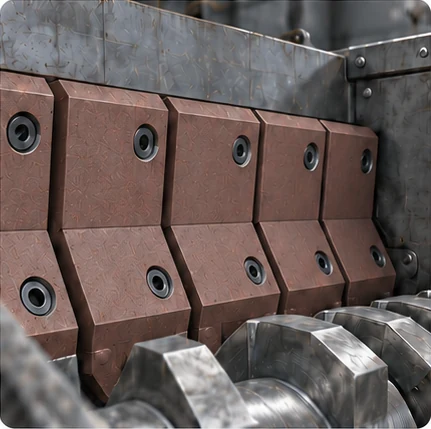
Generated concept of bolted wear liners inside an industrial shredder

Shredder liner assembly
Generated concept; not a project photograph.

Engineering Solution & Material Upgrade

Working closely with the client and our fabrication partners, Novelty Structures performed a thorough failure mechanism assessment. Rather than performing a direct like-for-like replacement, our engineering team specified an upgrade to premium Hardox® 500 wear plate liners.

Hardox® 500 is an abrasion-resistant steel with a nominal hardness of 500 HBW, engineered to withstand intense sliding and moderate impact wear. We designed and custom-fabricated precision-fit replacement liner plates, establishing a baseline intermediate upgrade step to evaluate long-term wear patterns

Field Performance & Quantitative Results

In field operation under actual shredding conditions, the custom Hardox® 500 liners performed exceptionally well, lasting an impressive four months—exactly double the two-month lifespan achieved by the previous mild steel liners. This reported doubling of wear life provided immediate operational and financial benefits to the client.

Performance Metric Mild Steel (Baseline) Engineered Hardox® 500 Operational Impact
Liner Operating Lifespan 2 Months 4 Months 100% Increase in Service Life
Maintenance Interventions 6 Replaces / Year 3 Replaces / Year 50% Reduction in Labor & Downtime
Wear & Damage Mechanism Rapid Sliding Erosion Controlled Uniform Thinning Retained Structural Integrity & Safety

Practical Lessons & Engineering Guidelines

  • Maintenance Interval Alignment: Assess replacement Hardox® 500 wear liners against the exact maintenance cycle required by the operation. Aligning component lifespan with plant overhaul schedules eliminates unscheduled shutdowns.
  • Baseline Parameter Recording: Before commencing a material trial, systematically document the existing failure mechanism, net operating hours, material throughput tonnage, and baseline replacement labor hours.
  • Wear Pattern Inspection: During routine maintenance inspections, distinguish between gradual, predictable thinning and catastrophic failure modes such as cracking, permanent plastic deformation, or attachment hardware failure. A longer wear life is beneficial only if the entire liner structural assembly remains safe and fit for service.
  • Application Context Sensitivity: While doubling liner life was achieved in this shredder application, achievable longevity gains depend directly on feed material abrasive index, drop impact energy, liner section geometry, and precision installation.

Case Study 2: Construction Machinery

A premier compaction equipment client specialising in heavy asphalt and soil rollers sought to enhance drum durability. Compaction equipment exposed to coarse, aggressive mineral aggregates experiences high surface abrasion. In oscillating rollers, a continuous grinding action occurs at the drum surface, making wear resistance a critical design priority.

However, implementing advanced wear-resistant steel in machine manufacturing presents a double challenge: the material must not only withstand brutal field conditions but must also remain fully workable within factory manufacturing parameters (bending, rolling, machining, and welding).

Material Selection & Production Validation

In collaboration with the client, we evaluated multiple advanced wear plate grades and selected Hardox® 450 (nominal hardness 450 HBW) for its optimal balance of high abrasion resistance, impact toughness, and outstanding workshop formability.

Our team established a dual-stage validation framework to de-risk the material transition:

Stage 1 — Workshop & Production Feasibility: First, a full-scale prototype vibrating compaction drum was manufactured to confirm that standard factory cold-forming, bending, welding, and surface machining equipment could process Hardox® 450 without excessive tool wear, micro-cracking, or dimensional distortion.

Stage 2 — In-Service Field Testing: Once production feasibility was established, the prototype roller drum was mounted on a heavy compaction machine and deployed directly into active road construction service with the client.
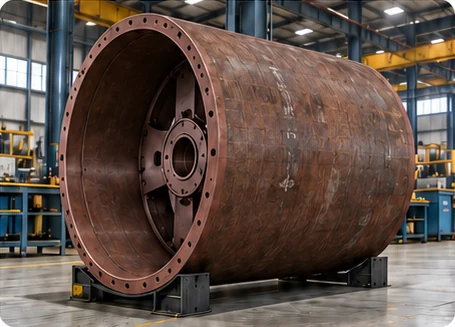
Generated concept of a fabricated compaction drum in a workshop

Compaction drum fabrication
Generated concept; not a project photograph.
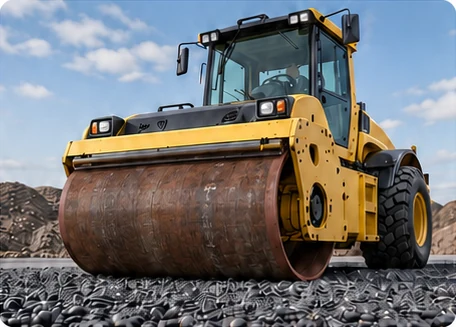
Generated concept of a compaction roller operating on aggregate

Roller field trial
Generated concept; not a project photograph.

Field Results & Long-Term Field Observation

After completing 1,000 rigorous operating hours under demanding aggregate compaction conditions, the drum underwent comprehensive field inspection. Field observation confirmed that initial workshop machining grooves remained clearly visible across the entire surface of the Hardox® 450 drum shell.

The retention of machining grooves after 1,000 hours of aggressive aggregate grinding provided concrete field evidence of Hardox® 450’s exceptional resistance to surface wear, establishing full confidence for series production.

Engineering Insight: Two-Stage Validation Framework for OEM Components

When introducing high-strength or wear-resistant steels (e.g., Hardox® 450) into curved or machined components, ALWAYS separate workshop production validation from field service validation.

  • Workshop Validation: Verify cold forming radiuses, weld joint preparation, weld consumable compatibility, residual stress management, and final geometric tolerances.
  • Field Validation: Deploy a representative trial component into real-world operating conditions and perform scheduled physical wear measurements before committing to full fleet adoption.

Case Study 3: Heavy Dump Bodies

In commercial transport and heavy earthmoving operations, vehicle gross weight limits strictly dictate maximum legal haul capacities. For weight-limited haulage vehicles, every kilogram of deadweight in the dump body directly reduces the net mass of material that can be legally transported.

A commercial transport manufacturing client approached Novelty Structures seeking to redesign a heavy-duty dump body. The existing design utilized conventional 10 mm thick structural steel plate (S355), resulting in an excessively heavy structure that limited total payload and increased fuel consumption during empty transit legs.
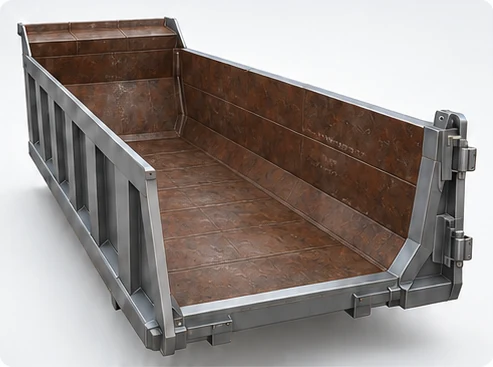
Generated concept of the wear plate layout inside a dump body

Dump body plate layout
Generated concept; not a project photograph.

Engineering Redesign & Thickness Optimization

Our engineering team designed a comprehensive structural redesign, substituting the heavy 10 mm structural steel plate with thinner, high-strength 8 & 6 mm Hardox® 450 wear plate. Because Hardox® 450 offers significantly higher yield strength, tensile strength, and hardness compared to standard mild steel, we trimmed plate thickness while maintaining superior resistance to impact denting, abrasive gouging, and structural deformation.

Design Specification Original Structural Steel Optimized Hardox® 450 Net Advantage
Plate Thickness 10 mm 8 & 6 mm 40% Thickness Reduction
Dump Body Tare Weight 3.4 Tonnes (3,400 kg) 2.6 Tonnes (2,600 kg) 800 kg Weight Reduction
Payload Capacity Baseline Payload Baseline + 800 kg Extra Payload Higher Revenue / Tonne-Kilometer

Operational Benefits & Payload Expansion

By implementing our thin-gauge Hardox® 450 design, the total mass of the dump body dropped from 3.4 tonnes to 2.6 tonnes. This achieved an immediate weight reduction of approximately 800 kg, directly converting deadweight into 800 kg of additional revenue-generating payload capacity per haul cycle.

Structural Engineering Considerations for Thin-Gauge Upgrades

Before specifying thinner Hardox® 450 plate, our engineers conduct rigorous structural analysis to evaluate key performance factors beyond wear resistance:

  • Operational Constraint Mapping: Determine whether the equipment’s productivity is limited primarily by gross vehicle weight limits, volumetric body capacity, or localized extreme impact loads.
  • Multi-Factor Structural Review: Evaluate section stiffness, localized dynamic impact resistance, cyclic fatigue limits, and weld joint attachment details alongside pure abrasive wear allowances.
  • Application Context Sensitivity: A successful plate thickness reduction in a dump body carrying granular gravel does not automatically translate to a quarry body handling large blasted rock masses.
  • Fabrication Enquiry Prerequisites: When submitting a fabrication or redesign enquiry, always provide existing body tare weight, current plate layout, material density/granulometry, and loading drop heights.

Best Practices

To ensure maximum reliability, structural integrity, and cost-effectiveness across all wear part installations, we adhere to standardized engineering guidelines during material selection, design, and routine maintenance.

Backing Structure & Substructure Inspection Protocols

An ultra-hard wear plate (such as Hardox® 550 or Hardox® 600) requires a rigid, flat, and well-maintained backing structure to perform reliably. High-hardness wear plates possess lower ductility; excessive bending or deflection in an unreinforced supporting shell can induce high residual stresses, leading to plate cracking or fastener failure.

Substructure Repair: Prior to releasing custom replacement liners for manufacture, inspect the supporting shell, frame, and mounting locations for thermal distortion, mechanical wear, or structural sagging. Resolve structural repairs before installation; upgrading material grade alone cannot compensate for a damaged mounting surface.

Section Size Optimization: Utilizing smaller, modular liner plate sections is a proven technique to mitigate structural deflection, accommodate thermal expansion, and minimize residual stress concentrations.
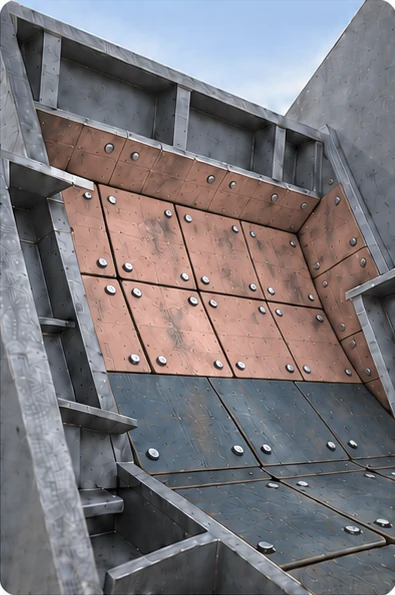
Generated concept of modular bolted liner plates and maintenance access

Modular liner access
Generated concept; not a project photograph.

Maintenance-First Design & Accessibility Checklist

An ultra-durable wear part can still create maintenance friction if fixings are unreachable or replacement plates cannot pass through existing access hatches. During design reviews, we enforce a 5-point maintenance checklist:

5-Point Design-for-Maintenance (DfM) Checklist:

  • 1
    Physical Maintenance Access: Can technicians easily reach fixing bolts and apply required torque tools with adequate clearance?
  • 2
    Extraction Route Clearance: Can worn liner plates be extracted safely through existing equipment access openings without cutting main structural frames?
  • 3
    Safe Handling & Lifting Points: Are designated lifting eyes, handling holes, or magnetic rigging points engineered into individual plate designs?
  • 4
    Unambiguous Part Tagging: Is every replacement part stamped with clear part numbers matching installation positioning drawings?
  • 5
    Modular Replacement Scope: Can heavily worn high-impact sections be changed independently without disturbing serviceable adjacent plates?

How can we help you ?

Selecting and fabricating the right wear-resistant material requires balancing workshop formability, structural design, maintenance access, and field wear mechanics. As demonstrated in these real-world case studies, our engineered solutions deliver quantifiable operational advantages—doubling component lifespan, eliminating unscheduled maintenance downtime, and increasing commercial payload capacity.

To consult with our engineering team on custom wear plate fabrication, structural redesign, or setting up a scientific wear trial, contact Novelty Structures.

FAQ

What makes Hardox steel unique?2024-12-25T00:52:11+00:00

Hardox steel combines hardness, toughness, and flexibility, making it ideal for heavy-duty applications. It resists wear, handles impact without cracking, and can be machined, cut, or welded like regular steel.

How do I choose the right grade of Hardox steel?2024-12-25T00:52:45+00:00

The choice of grade depends on your specific application:

  • For general wear resistance, choose Hardox 400 or 450.
  • For extreme wear conditions, opt for Hardox 500 or 600.
  • For structural components under heavy impact, Hardox HiTuf is ideal.
What thicknesses are available for Hardox steel?2024-12-25T00:53:19+00:00

Hardox steel is available in a wide range of thicknesses, from 2 mm (for lightweight applications) to over 100 mm (for heavy-duty uses).

How does Hardox compare to standard steel?2024-12-25T00:53:54+00:00

Hardox steel offers superior hardness, toughness, and wear resistance compared to standard steel. This means longer service life, reduced maintenance, and better performance under challenging conditions.

Can Hardox steel be customized for specific projects?2024-12-25T00:54:43+00:00

Yes! Hardox steel can be customized through cutting, machining, and processing to meet your unique requirements.

What is the delivery time for Hardox steel?2024-12-25T00:55:15+00:00

Delivery time depends on the grade, thickness and dimensions

Why should I choose Hardox over other wear-resistant steels?2024-12-25T00:55:58+00:00

Hardox steel stands out because of its consistent quality, proven durability, and versatility.

How is Hardox Steel manufactured?2024-12-25T00:56:43+00:00

Hardox steel is produced through a controlled rolling process, which results in a fine-grained microstructure. This microstructure contributes to its exceptional wear resistance and toughness.

Does Hardox steel work in cold climates?2024-12-25T00:57:19+00:00

Yes, Hardox steel maintains its toughness and impact resistance even in very low temperatures, making it suitable for cold environments like Arctic mining operations.

Can I use standard tools to process Hardox steel?2024-12-25T00:57:52+00:00

High-strength tools are recommended:

  • Drilling and Milling: Use carbide or cobalt-tipped tools.
  • Cutting: Plasma, laser, or oxy-fuel methods are most efficient.
  • Forming: Requires proper equipment and following bending guidelines for optimal results.
Is Hardox steel resistant to corrosion?2024-12-25T00:58:21+00:00

While Hardox steel is primarily designed for wear resistance, it can be treated with protective coatings to enhance its resistance to corrosion, especially in environments with high moisture or chemicals.
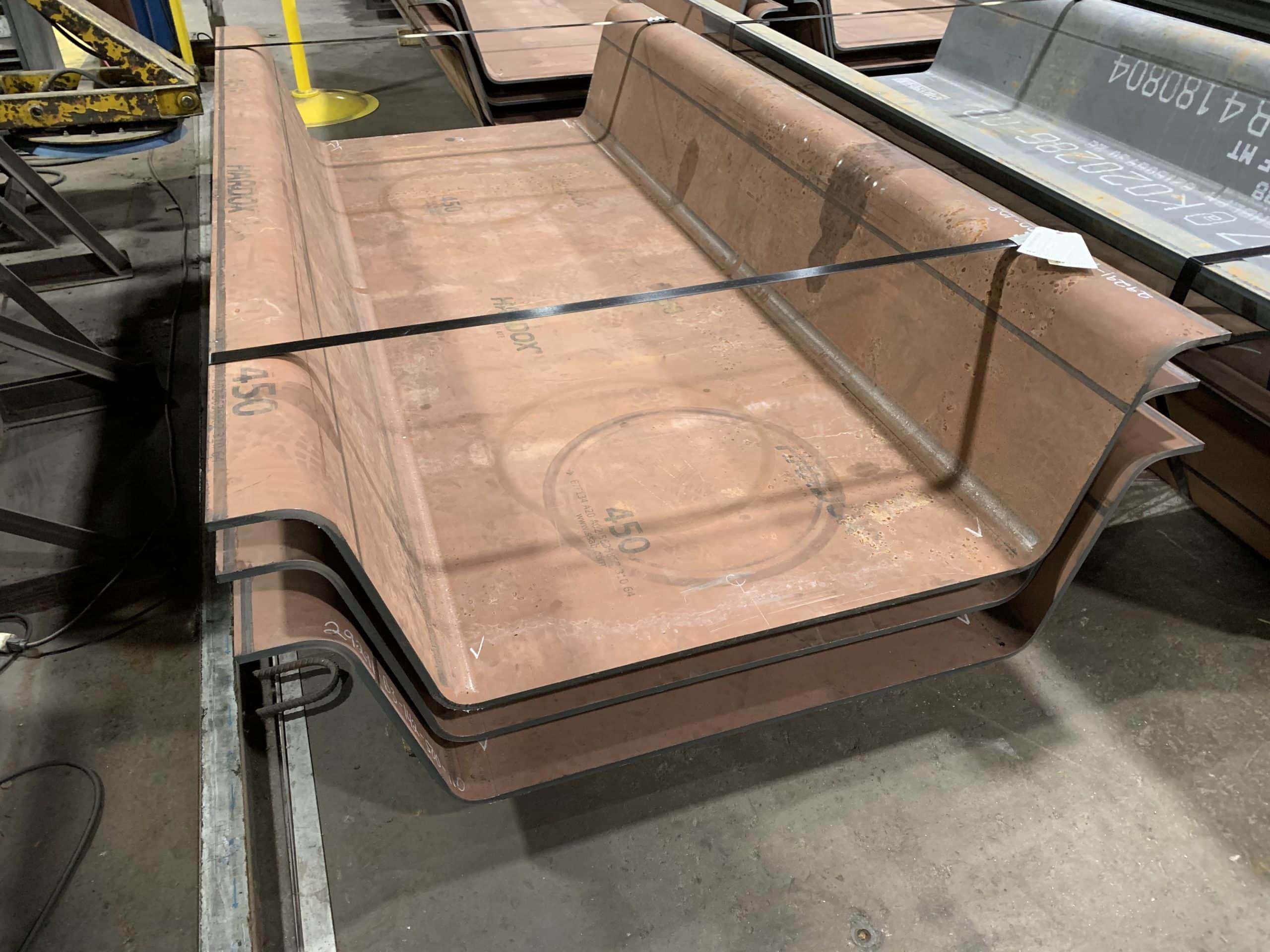
Hardox steel fabrication - bending

Knowledge Hub

Go to Top
